12 apps reviewed across two very different use cases: fertility tracking and TTC vs. week-by-week pregnancy. Here's who each one is actually for.

Pregnancy apps are a crowded, confusing category — partly because "pregnancy app" actually covers two very different problems.
Problem A: You're trying to conceive. You want to know when you're ovulating, track your cycle data, and maybe use OPKs or basal body temperature charting.
Problem B: You're already pregnant. You want a week-by-week guide, a place to log symptoms, and maybe some 3D visuals of what the baby looks like right now.
Most apps try to do both. A few specialize. Here's what's actually worth using.
These are for people actively trying to conceive. They focus on cycle data, ovulation prediction, and tracking.
Natural Cycles is the only app in this category with FDA clearance as a birth control method. It uses basal body temperature (measured each morning with a thermometer) plus an algorithm to identify fertile and non-fertile days.
That distinction matters: it's not just "cycle tracking" — it's a clinically validated method. The subscription ($13.99/month or $109.99/year) includes a free thermometer. If you want accuracy over convenience, this is the option.
Worth noting: Natural Cycles requires a thermometer and daily consistency to work properly. It's not for casual cycle logging.
Clue has always stood out for what it doesn't do: no pink color scheme, no "baby dust" language, no infantilizing UI. It tracks periods, ovulation, symptoms, mood, and more with a clear, science-based approach.
The free version covers basic tracking. Clue Plus ($9.99/month) adds cycle comparisons and partner access. If you want a no-nonsense tracker without the cutesy packaging that dominates this category, Clue is the choice.
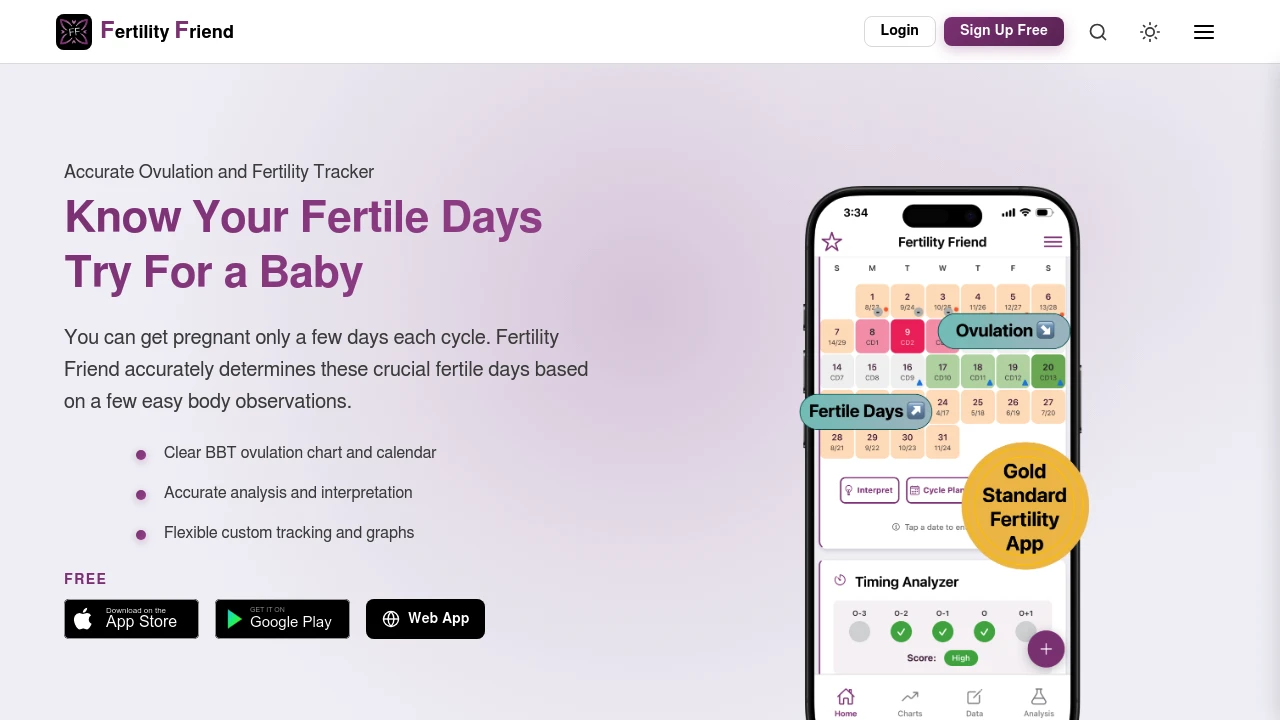
Fertility Friend has been around since 2001 and remains the tool of choice for anyone doing serious BBT charting. It supports basal body temperature, cervical mucus, OPK test results, and other fertility signs — and its charting engine will interpret the data and identify ovulation.
The interface is not modern. That's the trade-off for depth: nowhere else will you find this level of charting detail. If you're working with a fertility specialist or doing Creighton/Billings protocols, this is the tool.
Free tier includes basic charting. VIP membership ($45/year) adds advanced analytics.
Premom does something specific: you photograph your LH test strips (ovulation predictor kits), and the app reads the lines and stores the data. It turns a subjective "is this line dark enough?" question into a quantified trend.
If you're using OPK strips — especially Easy@Home or other compatible brands — Premom makes the data actually useful. It's free for basic use, with a subscription for advanced cycle analysis.
You're pregnant. These apps track the weeks, log symptoms, and give you something to read at 2am.
380 million downloads. Flo covers the full arc from period tracking through pregnancy to postpartum, which is why it dominates. Most people already have it by the time they need the pregnancy features.
The free tier is genuinely functional — week-by-week content, symptom logging, kick counter. Premium ($59.99/year) adds AI health assistant, cycle predictions, and more detailed insights. Honestly, the free tier is enough for most people.
If you already use Flo for cycle tracking, there's no reason to switch apps when you get pregnant.
The book has been in delivery rooms since the 1980s. The app carries the same brand recognition and covers week-by-week development, Q&A, and a community forum. It's not the most polished experience, but it's familiar, trusted, and free.
Good pick for anyone who grew up with the book or whose parents recommend it.
Pregnancy+ is the app to recommend for the 3D visuals. Each week comes with a detailed 3D model of fetal development — the kind of thing that makes the abstract feel concrete. It also includes a kick counter, contraction timer, and hospital bag checklist.
Free with optional Premium ($2.99/month) for additional content. The visuals alone make it worth downloading even if you're using another app as your primary tracker.
Ovia is part of a suite that covers fertility, pregnancy, and parenting — which makes it useful if you want continuity across phases. The pregnancy tracker includes personalized health insights based on your logged data and stands out for its depth of health-related content.
Free with optional premium features.
The Bump is a media brand first, app second. If you like their editorial content (articles, checklists, registry tools), the app packages all of it together. It's a reasonable choice for people who are already reading The Bump online and want everything in one place.
Glow Nurture is the pregnancy companion from Glow, the same company behind Glow Ovulation. It integrates smoothly with Glow's broader ecosystem if you used their fertility app before pregnancy. Covers standard week-by-week tracking, symptom logging, and partner sharing.
Two apps in this category are less about tracking and more about connection:
Peanut — a social network specifically for women navigating fertility, pregnancy, and motherhood. Think Facebook Groups, but purpose-built and moderated. Useful if you want to connect with others at the same stage.
BabyCenter — another media brand with a strong community forum component. The pregnancy calendar and development content are solid, and the forums have been active for decades.
For fertility tracking: Natural Cycles if you want clinical accuracy. Clue if you want clean data without commitment. Fertility Friend if you're doing serious BBT charting. Premom if you're using OPK strips.
For pregnancy tracking: Flo if you already have it. Pregnancy+ for the 3D visuals. Ovia if you want health-focused insights.
For both: Flo is the most complete single app across both phases. Ovia comes close.
Browse all Pregnancy & Fertility apps →
Next week: Baby Tracking Apps — feeds, diapers, milestones, and which apps are actually worth opening at 3am.
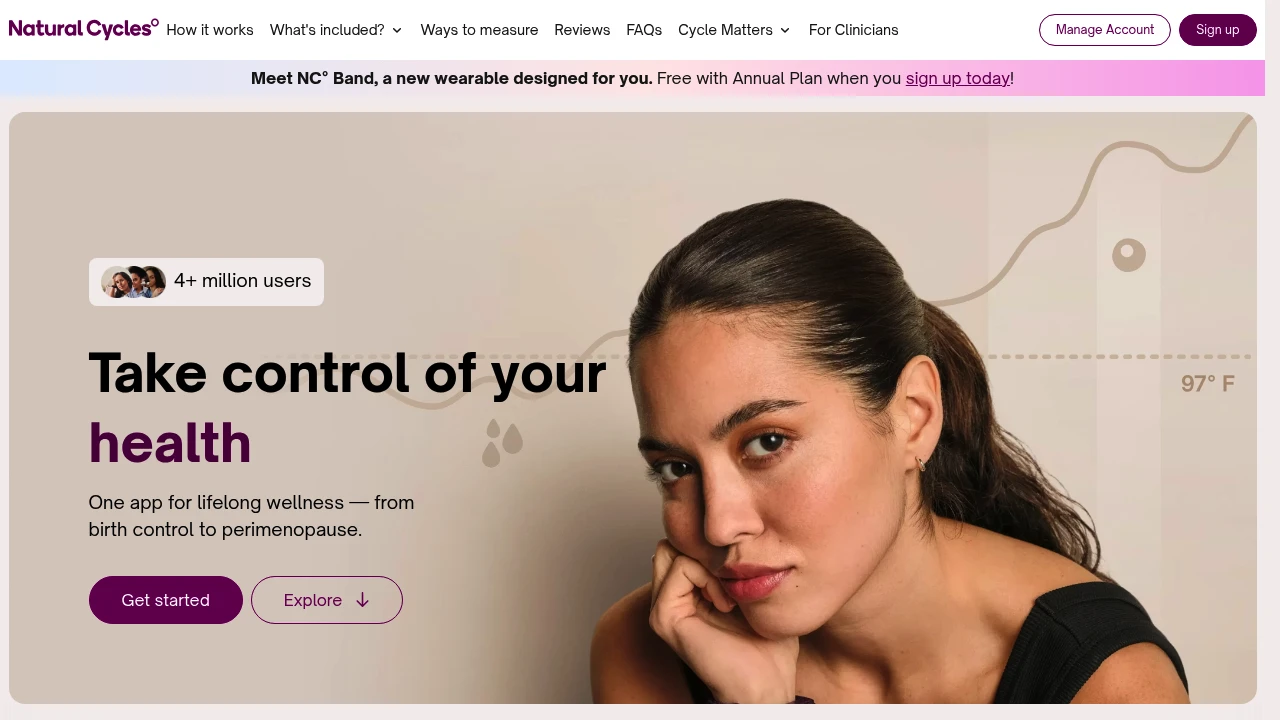
Natural Cycles is the first and only FDA-cleared app for use as birth control. You take your temperature every morning, the algorithm identifies your fertile days, and tells you whether to use protection. 93% typical use, 98% perfect use effectiveness. Three modes: Birth Control, Plan a Pregnancy, and Follow Pregnancy. Annual plan $119.99/yr includes a thermometer. Also works with Oura Ring and Apple Watch for overnight temperature. Not cheap, but cheaper than most contraception over time.

This is not a period tracker that also shows fertile days. Natural Cycles is FDA-cleared contraception. That's a meaningful regulatory distinction - it went through clinical trials, submitted safety data, and got cleared as a medical device for preventing pregnancy.
How it works: take your basal body temperature every morning before getting up (oral thermometer, or overnight via Oura Ring, Apple Watch, or the NC Band wearable). The algorithm analyzes temperature patterns to determine your fertile window. Green days = not fertile, use no protection. Red days = possibly fertile, use protection or abstain.
Effectiveness: 93% with typical use, 98% with perfect use. Comparable to the pill's typical-use rate. Not as effective as an IUD. Important to understand what "typical use" means - it accounts for human error (forgetting to take temperature, having unprotected sex on red days anyway).
Three modes: Birth Control (prevent pregnancy), Plan a Pregnancy (optimize timing for conception), and Follow Pregnancy (track your pregnancy once confirmed). The conception mode is solid - basically doing what Fertility Friend does with BBT but with a much nicer interface.
Annual plan: $119.99/yr with a thermometer included free. Monthly: $16.99/mo, thermometer sold separately for $39.99. FSA/HSA eligible.
Compared to Fertility Friend ($25-$45/yr), Natural Cycles is 3-5x the price but has a modern UI, FDA clearance, and wearable integration. FF is more powerful for charting obsessives. Natural Cycles is more practical for daily use.
Compared to Clue's Birth Control feature ($39.99/yr), Natural Cycles uses actual temperature data rather than cycle-history prediction, which is more biologically accurate.
The catch: you need to be consistent. If you hate morning routines or have irregular sleep schedules, the temperature readings will be unreliable. And on red days, you still need backup contraception. It's not effort-free.
Clue is the research-backed period and fertility tracker built with UC Berkeley, Harvard, and MIT partnerships. Gender-neutral design, no pink flowers, no cutesy language. Free version tracks 200+ cycle factors. Clue Plus (~$39.99/yr) adds 12-month predictions, analysis views, and an FDA-cleared contraceptive feature. If you want a period app that feels like a medical tool rather than a lifestyle brand, this is it. 10M+ users.
Clue doesn't look like other period apps. No pink. No flowers. No "feminine energy" branding. It looks like a data tool, because that's what it is.
Free version tracks periods, ovulation, 200+ symptoms (mood, energy, sleep, pain, sex drive), and gives cycle predictions. The interface is clean, fast, and doesn't assume anything about your gender identity or relationship status. That matters to a lot of people.
Clue Plus ($39.99/yr) adds: 12-month cycle predictions in calendar view, Analysis tab with statistical breakdowns of your typical cycle, unlimited custom tags, reminders, cycle sharing with partners, pregnancy mode, wearable sync, and expert content. The analysis tab is genuinely useful for doctor visits - shows your averages, deviations, and history at a glance.
The FDA-cleared birth control feature (Clue Birth Control) uses your cycle data to identify fertile days. It's a Digital Contraceptive, not just a calendar. Worth noting that Natural Cycles was first to get FDA clearance in this space and uses temperature data for higher accuracy.
Compared to Flo (380M+ users, $49.99/yr), Clue is less content-heavy but more data-rigorous. Flo has AI health assistant and video courses. Clue has research partnerships and cleaner analytics. Flo is the mainstream pick. Clue is the scientific one.
Privacy stance is strong - they've been vocal about not selling data and have published their privacy practices. Post-Roe, this matters.
If you're TTC (trying to conceive) and want serious charting, Fertility Friend goes deeper with BBT analysis. Clue is better as a general-purpose cycle tracker that happens to also do fertility.
Fertility Friend has been helping people get pregnant since 2003. It looks like it. The interface is dated, the design is cluttered, and none of that matters because the BBT charting and ovulation detection are the most accurate in the category. Tracks temperature, cervical mucus, OPKs, and 40+ signs. Free with 30-day VIP trial. VIP from $24.99/yr. If you're serious about TTC, this is where r/TryingForABaby sends everyone.

Fertility Friend looks like a website from 2005. It tracks like a medical device from 2025. That tension is the whole story.
The core feature is BBT (basal body temperature) charting with retrospective analysis. You take your temperature every morning before getting out of bed. FF analyzes the pattern and CONFIRMS ovulation after it happens - not just predicting based on calendar math. It cross-references with cervical mucus observations, OPK results, and 40+ other signs you can log.
This retrospective confirmation is what makes FF different from Clue or Flo, which primarily predict based on cycle history. Prediction tells you when ovulation might happen. Confirmation tells you it did happen. When you're timing intercourse for conception, that distinction matters.
Free version includes basic charting and a 30-day VIP trial. VIP ($24.99/yr renewal, $44.99/yr for new subscribers) unlocks advanced data analysis, pattern detection, pregnancy monitor, and priority support. No auto-renewal, which is oddly refreshing. You just buy the time you want.
The r/TryingForABaby subreddit treats FF as the default recommendation. The community knowledge base around reading FF charts is massive.
Available on iOS, Android, and a full web interface - the desktop version is actually the best experience for detailed charting.
Downsides: the UI is genuinely hard to navigate at first. There's a learning curve to understanding BBT charting itself. And if you're casually tracking cycles (not actively TTC), this is overkill. Use Clue instead.
For BBT tracking without the app complexity, Natural Cycles offers a cleaner experience with FDA-cleared birth control mode - but at $119.99/yr, it costs 5x more.
Premom is the first fertility app that reads ovulation test strips with your phone camera. Take a photo of your OPK, get a numerical LH reading instead of squinting at lines. Tracks cycles, predicts ovulation, logs BBT. Free basic version with OPK scanning. Premium adds advanced analytics. Also sells their own test strips and BBT thermometers. For the TTC parent who wants data without guesswork.
Every woman who's tried to conceive knows the squinting. Is that line darker? Is it the same? Is this a surge? Premom removes the guesswork - take a photo of your ovulation test strip, and the app gives you a numerical LH ratio instead of "maybe that's positive?"
The OPK (ovulation predictor kit) scanning works with most brands, though it's optimized for Easy@Home and Premom test strips (same parent company). Snap a photo, get a number, track the trend over days. When LH surges, you know it's time.
Beyond scanning: cycle tracking, ovulation prediction, BBT charting, period logging, and fertility insights. Free version includes OPK scanning and basic tracking. Premium adds advanced analytics and features.
Compared to Fertility Friend ($25-$45/yr, BBT charting specialist), Premom is more accessible and visual. FF is the charting powerhouse for data obsessives. Premom is the entry point for TTC parents who want simple, visual answers - "take photo, see number, know when."
Compared to Natural Cycles ($119.99/yr, FDA-cleared contraception), Premom is TTC-focused while Natural Cycles works for both preventing and planning pregnancy. Natural Cycles uses temperature only. Premom adds OPK data.
Compared to Clue ($39.99/yr), Premom is specifically designed for conceiving. Clue is a general cycle tracker that happens to show fertility windows. If you're actively trying, Premom's OPK scanning is a real advantage.
The company also sells test strips, pregnancy tests, BBT thermometers, and supplements - it's an ecosystem play. The strips are cheap (bulk packs on Amazon) and the scanning integration is seamless.
Flo is the biggest period and pregnancy app in the world. 380M+ users. Free version tracks periods and ovulation with ads. Premium ($49.99/yr) removes ads and adds AI health assistant, video courses, symptom checker for PCOS/endometriosis/fibroids, and detailed pregnancy tracking. FSA/HSA eligible. It's the safe mainstream choice - not the most specialized at anything, but covers everything from first period to perimenopause.
You probably already have Flo. 380 million people do. It's the default period tracker the same way Google Maps is the default navigation app - not because it's the absolute best at any one thing, but because it covers everything well enough.
Free version: period and ovulation predictions, cycle calendar, health library with hundreds of articles. Has ads. Premium ($49.99/yr or $9.99/mo) removes ads and unlocks: personalized daily insights, expert-led video courses on fertility/pregnancy/birth, Symptom Checker for PCOS, endometriosis, and fibroids, detailed pregnancy mode for every trimester, and a 24/7 AI Health Assistant.
The pregnancy mode is seamless - when you log a positive test, Flo transitions from cycle tracking to week-by-week pregnancy tracking with fetal development updates, symptom logging, and appointment reminders. That continuity is genuinely convenient vs switching to a separate pregnancy app.
New features include Perimenopause Score and Menopause Timeline for tracking that transition. Rare for a period app to cover the full reproductive lifespan.
FSA/HSA eligible, which is a nice perk if your employer plan supports it.
Compared to Clue ($39.99/yr), Flo has more content (courses, articles, community) but less scientific rigor in its branding. Clue is data-first. Flo is content-first. Compared to Ovia, Flo is consumer-focused while Ovia is employer-sponsored. Compared to Fertility Friend, Flo's fertility tracking is basic - if you're actively TTC with BBT charting, FF is far more powerful.
Privacy has been a concern - Flo settled with the FTC in 2021 over sharing health data with third parties. They've since introduced Anonymous Mode. Worth knowing.
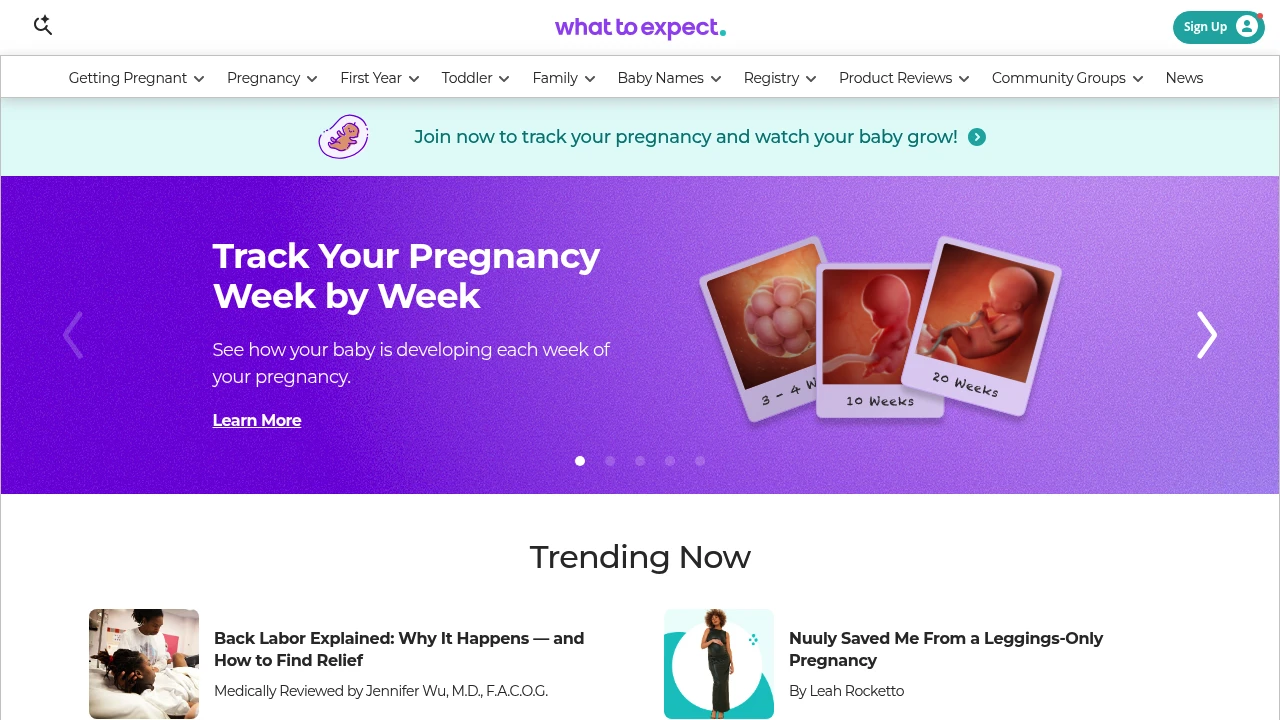
What to Expect is the app version of the pregnancy book your mother gave you. Daily updates, week-by-week fetal development, symptom tracking, and a massive community. 4.9 stars, 336K+ reviews. Free. From the brand that's been the default pregnancy resource since 1984. Covers TTC through baby's first year. The editorial content is unmatched in depth and trust.

Your mom read "What to Expect When You're Expecting." Now there's an app. Same trusted brand, same editorial depth, phone-sized.
Daily pregnancy updates tailored to your due date. Week-by-week fetal development with size comparisons. Symptom tracker. Health and nutrition guides. Birth plan builder. Baby name finder. Community forums organized by due date month. Continues after birth with baby development tracking through the first year.
4.9 stars across 336K+ reviews. Free. No premium tier. No paywall. Funded by advertising.
The editorial content is the real asset. This isn't AI-generated filler. What to Expect has been producing medically-reviewed pregnancy content since 1984. The depth and accuracy are unmatched - when you Google a pregnancy question, What to Expect is usually in the top results for a reason.
Community forums are massive and active. Your "August 2026 Babies" birth group becomes a support system that lasts well beyond pregnancy. Real parents, real questions, real-time support.
Compared to The Bump (free, 3D models, registry integration), What to Expect has stronger editorial content and a more established community. The Bump has better registry features and a more modern design. Both are free. Many parents use both.
Compared to Flo ($49.99/yr for premium), What to Expect is purely pregnancy/baby focused while Flo covers the full reproductive lifecycle. Flo has AI health assistant. What to Expect has decades of editorial trust.
Compared to Pregnancy+ (Philips Avent, 3D models), What to Expect wins on content depth. Pregnancy+ wins on 3D visualizations. Different strengths.
The book is optional. The app stands on its own. But if someone gifts you the book, read it too.
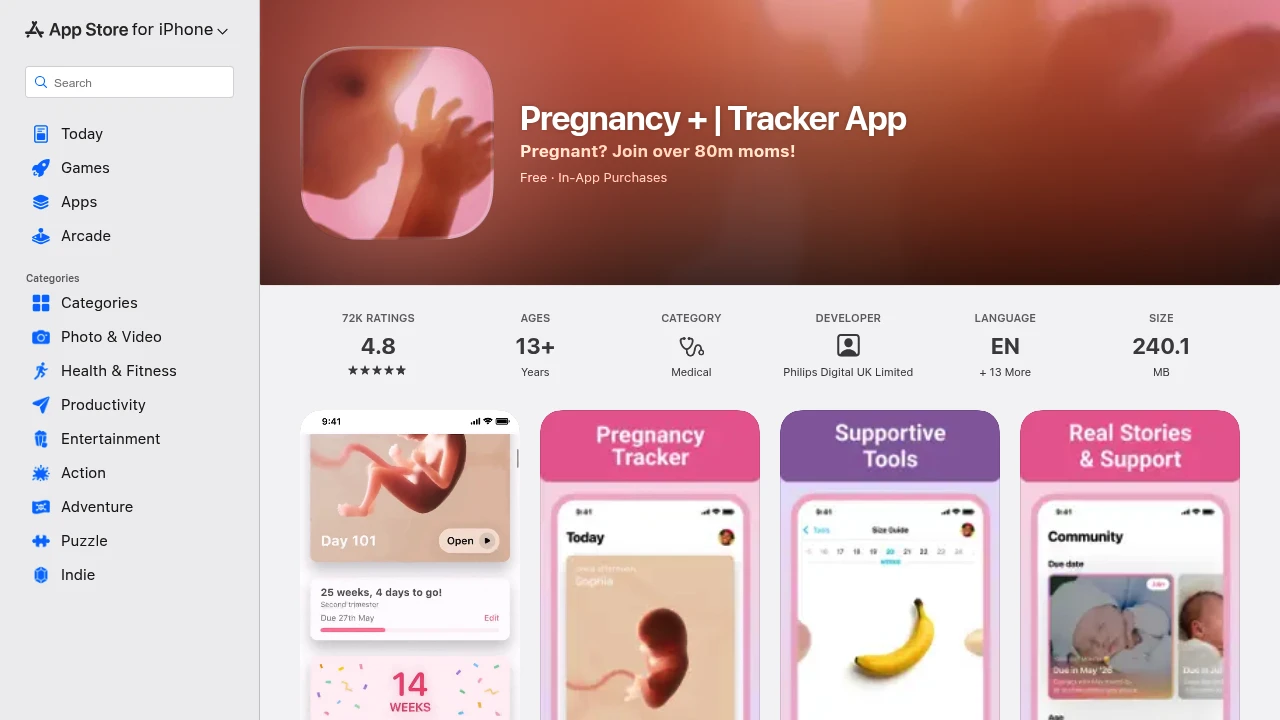
Pregnancy+ has 80M+ downloads and the best 3D baby visualizations in the category. Interactive 3D models show your baby's development week by week - you can rotate, zoom, and see organ development. Daily updates, size comparisons ("your baby is the size of a mango"), contraction timer, kick counter, and hospital bag checklist. By Philips Avent. Free with premium subscription for full access.

The 3D baby models are why people download this. Rotate your baby in 3D, watch organs develop week by week, see how big they are compared to fruits and vegetables. It's the most visually impressive pregnancy tracker available. 80M+ downloads.
Weekly updates tell you what's developing this week, what to expect with your body, and what to ask at your next appointment. Daily content keeps it fresh. Size comparisons make it tangible - "your baby is the size of a papaya this week."
Practical tools: contraction timer, kick counter, weight tracker, appointment log, hospital bag checklist, and a baby name finder. Covers the full pregnancy toolkit.
By Philips Avent - a brand parents already know from bottles and breast pumps. Free basic version with premium subscription for full access to all content and tools.
Compared to Flo ($49.99/yr), Pregnancy+ is more pregnancy-focused while Flo covers the full cycle-to-pregnancy-to-menopause spectrum. Flo has a larger community and more editorial content. Pregnancy+ has better 3D visualizations.
Compared to The Bump (free, 3D models, registry integration), both have 3D baby models but Pregnancy+ was first and the models are more detailed. The Bump adds registry features Pregnancy+ doesn't have.
Compared to What to Expect (free, editorial powerhouse), Pregnancy+ is more visual while What to Expect is more written-content-heavy. Different strengths for different learning styles.
If you want to SEE your baby developing in 3D, this is the app. If you want to READ about it, What to Expect. If you want to track everything in one app forever, Flo.
Ovia is the pregnancy tracker that's often free through your employer's health benefits. Basic version covers weekly development, symptom tracking, food safety lookups, kick counter, and contraction timer. Employer-sponsored premium adds health coaching, personalized content, and programs for specific conditions. No ads, no paywalls if your company participates. Check with HR. If your employer doesn't sponsor it, the free version still works but you'll find more features in [Flo](/flo-period-pregnancy-tracker) or [Glow Nurture](/glow-nurture).
Ovia's business model is different from every other app here. Instead of charging you, they charge your employer. Companies buy Ovia as a health benefit for employees. If your workplace participates, you get the full premium experience - health coaching, personalized content, condition-specific programs - at no cost to you.
Even without employer sponsorship, the free version is solid: week-by-week baby development updates, symptom and mood tracking, food safety lookup (can I eat sushi?), medication safety checker, kick counter, contraction timer, weight and nutrition logging, appointment scheduler, and a community feature.
The food and medication safety tools are especially useful. Instead of Googling "can I eat brie pregnant" at a restaurant, you search in Ovia and get a clear yes/no with explanation.
Friends and family sharing lets your partner follow along with daily updates without needing to ask "how are you feeling?" every five minutes.
Premium (via employer): health coaching with real people, personalized content algorithms, programs for gestational diabetes, preeclampsia, postpartum depression, and more. UnitedHealthcare members can get Ovia+ at a discount.
The catch: if your employer doesn't sponsor Ovia, the free version is fine but unspectacular. Flo ($49.99/yr) gives you more content and AI features for a consumer price. Glow Nurture ($60/yr) has better comparative analytics. The Bump and What to Expect are fully free alternatives with strong editorial content.
Privacy note: since your employer is the customer, there are legitimate questions about what health data flows back to them. Ovia says it's aggregated and de-identified. Read the privacy policy yourself.
Check with your HR department first. If it's covered, use it. If not, you have better free options.
The Bump is a free pregnancy app with interactive 3D baby models, daily content, baby name finder (with origin, meaning, and popularity trends), and direct registry integration. Week-by-week updates, size comparisons, community forums, and a hospital bag checklist. From the same company as The Knot. Fully free - no premium tier, no paywall. The registry integration makes it unique.

The Bump does pregnancy tracking, baby naming, and registry building in one free app. That combination is unique - most pregnancy apps stop at tracking.
3D baby models show weekly development. Daily content covers what's happening with your body and baby. Size comparisons ("your baby is the size of a cauliflower") give you something to tell your partner. Standard pregnancy app features done well.
The baby name finder is genuinely useful. Search by origin, meaning, popularity trends over decades, and what names are rising or falling. Way better than Googling "baby names 2026."
Registry integration: connect your registries from Amazon, Target, Buy Buy Baby, and others. Friends and family can see your registry through The Bump. This bridges the gap between "tracking my pregnancy" and "getting ready for the baby" that other apps don't cross.
Active community forums organized by birth month. Your "July 2026 Babies" cohort goes through everything together - from first kicks to labor stories to postpartum support.
Completely free. No premium tier. No paywalls. Funded by advertising and registry partnerships.
Compared to Pregnancy+ (Philips Avent, 80M+ downloads), both have 3D models. Pregnancy+ has more detailed medical visualizations. The Bump has better content and the registry feature.
Compared to What to Expect (the book's app), The Bump is a younger brand with more modern UX. What to Expect has decades of editorial trust. Both are free. Try both and keep whichever you prefer.
From The Knot (wedding planning) parent company - they know how to build content platforms around life milestones.
Glow Nurture is the pregnancy piece of Glow's reproductive health suite. Free version covers due date calculator, weekly baby development, symptom logging, and weight tracking. Premium ($60/yr) adds comparative insights ("is this normal?"), premium articles, and priority support - and works across all Glow apps (fertility, pregnancy, baby). The ecosystem play is the real selling point. If you already use Glow for cycle tracking, Nurture continues the data.

Glow runs a suite of reproductive health apps: Glow (fertility), Nurture (pregnancy), Baby (postpartum), and Community. One subscription works across all of them. That's the pitch - track from TTC through pregnancy through baby's first year without switching apps or losing data.
Nurture specifically covers pregnancy. Free features: due date calculator (uses Parikh's Formula, slightly more accurate than the standard Naegele's rule), week-by-week fetal development, symptom and weight logging, contraction timer, kick counter, appointment tracker. Up to 6 premium articles per week free.
Premium ($59.99/yr after 7-day trial, or $79.99 lifetime) adds: comparative insights ("is this normal?" with data from millions of users), full premium article access, custom profile, and priority support. The comparative data is actually useful - seeing that 62% of women at 28 weeks also have back pain is oddly comforting.
Compared to Flo ($49.99/yr), Glow Nurture is more pregnancy-focused while Flo covers the full cycle-to-menopause spectrum. Compared to Ovia (free via employer), Nurture has a similar feature set but you pay for it yourself. Compared to The Bump or What to Expect, Glow is more data-driven and less editorial/content-heavy.
The community feature is active but can be overwhelming - lots of posts, not always well-moderated. Take the crowdsourced advice with a grain of salt.
If you're already in the Glow ecosystem from TTC, continuing to Nurture is a no-brainer. If you're starting fresh during pregnancy, Flo or Ovia might offer more for less.